

LMIA Processing Times in Canada 2026, Why Delays Are Increasing and What You Should Do
Published on April 05th 2026 by Fairworld Immigration
If you are planning to apply for a work permit through LMIA in Canada, timing has become one of the biggest challenges in 2026. Many employers and foreign workers are now experiencing longer wait times, delayed hiring decisions, and increased uncertainty.
Recent data and industry updates confirm that LMIA processing times in Canada in 2026 are rising, especially for certain streams and regions.
But the real question is not just how long it takes. The real question is:
What does this mean for your application, and how can you avoid delays or refusal?
This guide explains everything you need to know.
Contact RCIC at Fairworld Immigration Consulting Today!
What is an LMIA and Why Does it matter?
A Labour Market Impact Assessment, or LMIA, is a document that employers in Canada must obtain before hiring most foreign workers.
It proves that:
- No Canadian worker is available for the role
- Hiring a foreign worker will not negatively impact the labour market
Without a positive LMIA, many work permit applications cannot proceed.
Why LMIA Processing Times in Canada Are Increasing in 2026

There are several key reasons why LMIA processing times in Canada 2026 are rising.
1. Policy Changes and Reduced Worker Targets
Canada is adjusting its temporary resident strategy, including reducing the number of temporary foreign workers admitted under certain programs.
This shift is part of a broader effort to manage population growth and labour market balance.
While fewer admissions may sound like faster processing, in reality it creates:
- Stricter assessments
- More detailed reviews
- Increased scrutiny on employers
2. Increased Application Complexity
LMIA applications today require:
- Detailed recruitment proof
- Job market analysis
- Wage justification
- Employer financial validation
Service Canada officers are reviewing applications more carefully than before, which naturally increases processing time.
3. High Demand in Certain Industries
Industries such as:
- Construction
- Healthcare
- Hospitality
- Transportation
continue to rely heavily on foreign workers.
High demand leads to:
- More LMIA submissions
- Longer queues
- Slower processing overall
4. Variation Across LMIA Streams
Processing times are not the same for all LMIA categories.
For example:
- High-wage roles may take around 60 business days
- Global Talent Stream applications can be processed much faster
- Low-wage and PR-related streams may take significantly longer
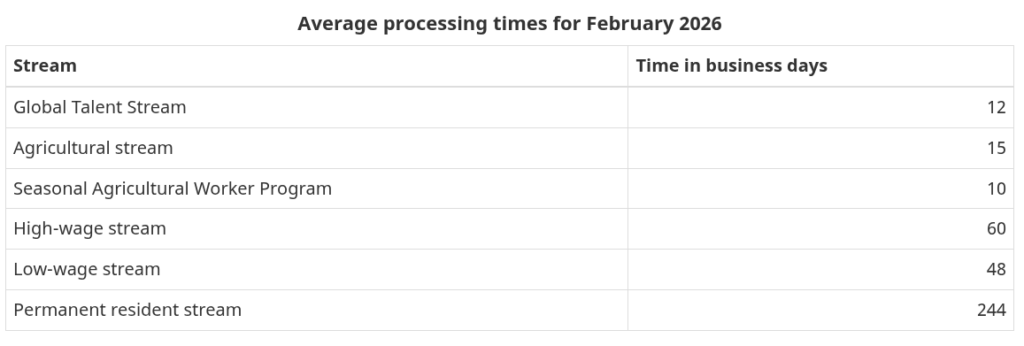
Access Current and Official LMIA Processing Times from the IRCC Website.
How Long Does an LMIA Take in Canada in 2026
There is no single answer.
On average, standard LMIA applications can take 2 to 4 months or more, while some streams are faster, and others are significantly slower
LMIA Processing times in Canada depend on:
- Application completeness
- Employer credibility
- Job category
- Region
- Government workload
Important: These timelines are averages, not guarantees
What LMIA Delays Mean for Employers
For employers, delays can create serious business challenges.
Hiring Delays
Projects may be delayed due to lack of workers.
Increased Costs
Longer timelines can increase operational costs.
Loss of Talent
Qualified candidates may accept other offers while waiting.
This is why employers need a clear and structured LMIA strategy.
What LMIA Delays Mean for Foreign Workers
For workers, delays can impact:
- Job start dates
- Visa validity
- Financial planning
- Immigration timelines
Many applicants also risk losing opportunities due to slow processing. Learn more on our work permit page.
How to Avoid LMIA Delays and Improve Approval Chances
This is where most applicants make mistakes.
1. Submit a Complete and Strong Application
Incomplete applications are one of the biggest causes of delay.
Ensure:
- All documents are included
- Job descriptions are detailed
- Recruitment efforts are clearly documented
2. Choose the Right LMIA Stream
Different streams have different processing times.
For example:
- Global Talent Stream offers faster processing for specific roles
Choosing the wrong stream can cost you weeks or months.
3. Ensure Employer Compliance
Employers must:
- Meet wage requirements
- Follow recruitment rules
- Provide accurate business information
Even small mistakes can lead to delays or refusal.
4. Plan Early
In 2026, last-minute applications are risky.
LMIA timelines should be factored into:
- Hiring plans
- Immigration strategy
- Work permit timelines
LMIA vs LMIA-Exempt Work Permits in 2026
With increasing delays, many applicants are exploring LMIA-exempt options such as:
- Francophone Mobility Work Permit
- Intra-company transfers
- Spousal open work permits
Francophone Mobility Work Permit is the most in-demand and streamlined work permit as of early 2026.
These options can significantly reduce waiting time if eligibility requirements are met.
Why Working With an RCIC Matters More Than Ever
In 2026, LMIA applications are not just forms. They are detailed legal and compliance submissions.
Working with a licensed RCIC helps:
- Avoid errors
- Reduce delays
- Improve approval chances
- Ensure compliance with IRCC and ESDC rules
At Fairworld Immigration Consulting, we help both employers and workers navigate LMIA applications with clarity and confidence.
✔ 100 percent success rate
✔ 100 percent client satisfaction
✔ 100 percent five star Google reviews
Final Step: Get Expert Guidance Before You Apply
If you are planning to apply for an LMIA or facing delays, do not rely on guesswork.
📞 Call: 604 902 6356
📧 Email: mgn@fairworldimmigration.ca
Let Fairworld Immigration help you move forward with a clear strategy.
LMIA Processing Times In Canada Will Continue to Matter in 2026
LMIA processing times in Canada are rising due to policy changes, demand, and stricter review processes. Understanding these changes is essential for both employers and foreign workers. With the right preparation and guidance, delays can be managed and success becomes much more achievable.